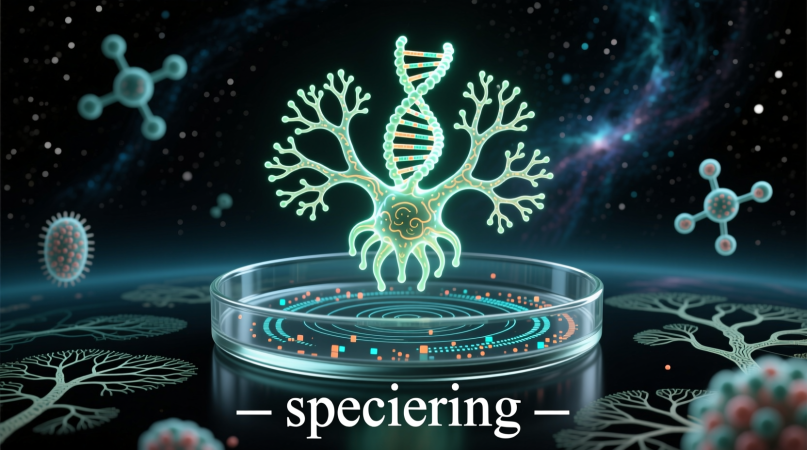
Speciering is a well-established term in evolutionary biology that refers to the process by which populations of organisms diverge genetically to the point where they become distinct species. This process typically involves mechanisms such as:
- Genetic drift: Random changes in allele frequencies within isolated populations.
- Natural selection: Differential survival and reproduction based on advantageous traits.
- Reproductive isolation: The emergence of barriers (prezygotic or postzygotic) that prevent gene flow between populations.
The outcome of speciation is the formation of two or more distinct species that are reproductively isolated from one another. Speciation is central to understanding biodiversity and the tree of life.
Key characteristics of the term:
- It is precise and rooted in biological theory.
- It has a clear operational definition tied to observable phenomena (e.g., genetic divergence, reproductive barriers).
- It aligns with the broader framework of evolutionary biology and related disciplines.
Speciering: A Conceptual Extension
The term “speciering” does not currently exist in scientific literature, but your suggestion to use it metaphorically or conceptually opens up interesting possibilities. If we were to adopt this term, it could serve as a bridge to describe analogous processes in other domains where “differentiation” or “branching” occurs. it might be framed:
1. Dynamic Nature of Species Formation
In biology, “speciering” could emphasize the ongoing, active process of differentiation rather than just the endpoint of speciation. For example:
- Instead of focusing solely on reproductive isolation, “speciering” might highlight the continuous interplay of ecological pressures, genetic mutations, and environmental changes driving divergence.
- This framing could encourage researchers to think about speciation not as a discrete event but as part of a continuum.
2. Cross-Disciplinary Applications
The metaphorical extension of “speciering” could apply to fields beyond biology, where similar patterns of branching or diversification occur. Examples include:
- Chemistry: The creation of new molecular structures through chemical reactions (e.g., polymerization leading to diverse materials).
- Marketing: The segmentation of consumer markets into distinct groups based on preferences or behaviors.
- Technology: The development of specialized tools or software platforms tailored to specific tasks.
- Cultural Evolution: The emergence of distinct cultural practices or languages due to geographic or social isolation.
By using speciering one could draw parallels between these processes and biological speciation, fostering interdisciplinary dialogue.
3. Philosophical Implications
Speciering might also capture a philosophical perspective on change and diversity. For instance:
- In systems theory, it could describe the spontaneous organization of complex systems into differentiated components.
- In art or design, it could refer to the creative exploration of variations within a theme.
Potential Challenges with “Speciering”
While “speciering” offers an intriguing conceptual extension, there are potential challenges to its adoption:
- Lack of Standardization: Without a formal definition, the term risks being ambiguous or misinterpreted.
- Overgeneralization: Applying “speciering” too broadly might dilute its connection to biological speciation, making it less useful in scientific contexts.
- Resistance from Academia: Scientists often prioritize established terminology for clarity and rigor, so introducing a new term would require strong justification and widespread acceptance.
Proposed Framework for “Speciering”
To address these challenges, here’s a possible way to define and contextualize “speciering”:
- Definition:
- it refers to the dynamic process of differentiation or branching in any system, whether biological, chemical, technological, or cultural. It emphasizes the fluidity and adaptability inherent in the formation of distinct entities.
- Relationship to Speciation:
- Biological speciation represents a specific instance of “speciering.”
- Other forms of “speciering” share common principles with speciation, such as divergence, adaptation, and the emergence of unique identities.
- Applications:
- Biology: Traditional speciation studies.
- Chemistry: Formation of novel compounds or polymers.
- Marketing: Market segmentation strategies.
- Technology: Development of specialized algorithms or devices.
- Culture: Emergence of subcultures or dialects.
- Benefits:
- Encourages interdisciplinary thinking.
- Provides a unifying language for discussing differentiation across fields.
- Highlights the universality of branching processes in nature and human endeavors.
Conclusion
While “Speciering” remains the gold standard in biological discourse, “speciering” offers a rich conceptual framework for exploring analogous processes in diverse domains. By carefully defining and situating it alongside speciation, we can foster greater understanding of how differentiation operates at multiple scales—from genes to ecosystems to societies.
If you’re considering developing this idea further, I recommend creating a formal definition and testing its utility in various contexts. This could involve writing a paper or article that introduces it meta-concept bridging science, technology, and culture.
Leave a Reply